

The Lovers'
Journey
The Hidden Code of
Life and Evolution
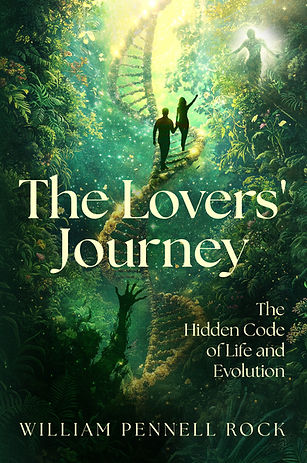
The Lovers' Journey
The Hidden Code of Life and Evolution
Why do the great stories of love, told across centuries and cultures, return again and again to the same underlying pattern?
The Lovers’ Journey reveals a recurring pattern within stories of love and what it tells us about the nature of transformation. The book names this underlying structure the Romance Archetype and traces its implications far beyond storytelling, into psychology, spirituality, human transformation and evolution itself.
“ The seminal idea of the twenty-first century.”
— Jean Houston
A Lifetime in Search of a Missing Archetype
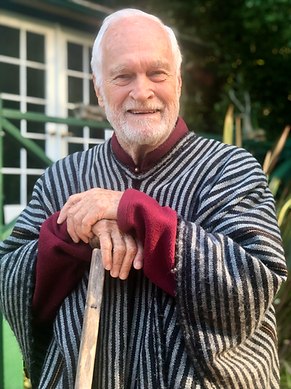
For more than fifty years, William Pennell Rock pursued a question that reached far beyond romantic love:
Could the great stories of relationship reveal a fundamental pattern of human transformation?
His search took him through mythology, psychology, comparative religion and philosophy, and eventually into decades of teaching and experiential workshops devoted to exploring these patterns in personal experience.
The Lovers’ Journey is the culmination of that search.
What Is The Lovers' Journey?
Mythologist Joseph Campbell introduced the Hero's Journey to a wide modern audience, revealing an archetypal pattern of adventure and individual transformation.


One protagonist. One transforming individual.
The Hero leaves home, enters the unknown, undergoes initiation and returns transformed.
Rock came to see another great journey hiding in plain sight. In the enduring stories of lovers who are separated and ultimately reunited, there are two protagonists, and what undergoes transformation is their relationship. He calls this pattern the Romance Archetype.


Two protagonists. One transforming relationship.
The Lovers begin in union, are separated and tested, and reunite at a new level. The Yin-Yang symbol represents the complementary polarity at the heart of their relationship.
A Universal Story in Many Forms
Rock found the same underlying pattern of separation and reunion in stories that arose in very different cultures, periods and traditions.

SACRED EPIC
The Ramayana

POPULAR ROMANCE
The Romance Novel

LITERATURE
Pride and Prejudice

CHINESE CLASSIC
The Peony Pavilion

FAIRY TALE
Cinderella

MODERN CINEMA
The Notebook
The Romance Archetype
The Lovers' Journey reveals how this recurring pattern of separation and reunion unfolds through four characters and five acts.
The Four Characters

The four characters form two complementary pairs: the Hero and Heroine are the Lovers whose relationship is transformed; the Nurturer and Saboteur are the assisting and opposing forces that influence their journey.
The Five Acts
The five acts trace the Lovers’ Journey from union, through separation and conflict, to a reunion at a new level.

Reunion at a New Level
The journey does not end with a return to the beginning. Through separation, intervention and conflict, the Lovers and their relationship are transformed. Reunion takes place at a new level of integration.
Why the Romance Archetype Matters
When we say “I am a new person” we are recognizing transformation. Something fundamental has changed in who we are. We thus understand this key concept of transformation as a change from one state of being to another.
The Hero’s Journey and the Lovers’ Journey arise from a universal human intuition of how transformation takes place. They are not just formulas invented by storytellers, but intuitively generated archetypal patterns, each showing how transformation happens in its own distinct way.
Both have enormous practical value as guides to storytellers. Campbell's Hero's Journey has profoundly influenced writers, artists and thinkers throughout the world by showing the universal structure beneath all stories of adventure. The Romance Archetype offers a comparable guide to creating, refining, and critiquing Romances.
While the Hero and Heroine at the story level may embody culturally prescribed roles for men and women, The Lovers’ Journey explores their deeper archetypal significance. Through an in-depth study of four great world romances, the book reveals the universal structure and subtle dynamics of relationship transformation leading through separation, conflict and reunion.
The archetypal Lovers embody complementary capacities that exist in all of us: the Hero, active/masculine/Yang; and the Heroine, receptive/feminine/Yin. The Lovers encounter opposing forces: the Saboteur, who drives them apart, and the Nurturer, who enables their transformation and reunion.
Understanding this Archetype opens rich new possibilities for storytelling, psychological transformation, and the relationships through which we become whole.
From Story to Transformation
For twenty-five years, Rock explored the Romance Archetype’s creative and psychological potential through his ORIGINS psychodrama workshops. Participants in the workshops generated, enacted and then analyzed their own unique inner dramas of transformation. Then, bonded as a group, they developed original works of theater, dance and ritual performance. These projects revealed possibilities extending far beyond artistic creation.
Nothing contributes more to understanding the meaning of the Archetype than tracing and experiencing your own Inner Romance. The Archetype is a foundational pattern of your existence. The challenges you face in the present are unfolding within a larger cycle of transformation. By recognizing the Four Characters and Five Acts at work in your own life, you can identify the nature of your present trials and crises, and project a viable way forward.
Although we are barely aware of these inner Romances, their cycles constitute the process of our maturation, or Individuation. Our fascination with romance stories arises not merely from the emotional pleasure they give us, but from their capacity to awaken recognition of the transformative dramas unfolding within ourselves. This helps explain our seemingly inexhaustible appetite for them and the deep satisfaction they bring.
Experiencing the Archetype within ourselves illuminates the forces of conflict, sabotage and renewal that shape our inner lives, relationships and communities, offering new approaches to psychospiritual development, psychotherapy and the realization of our human potential.
The Hidden Code of Life and Evolution
The book's most far-reaching discovery emerges when Rock recognizes that the elements of the Romance Archetype correspond to the fundamental pattern of evolution. Everything that exists and evolves is a whole/part. This is called a "holon," that is, a whole that is part of greater wholes and composed of lesser wholes. Philosopher Ken Wilber has extensively explored the nature of holons and their development as the “pattern that connects.”
Rock recognizes that the fundamental tendencies of holons as laid out by Wilber correspond to the Four Characters of the Romance Archetype, while the dynamics of their transformation correspond to its Five Acts. Through this correspondence, Rock proposes that the Archetype describes not only the transformation of humans, but of all beings generally, revealing the lawful pattern through which each successful transformation constitutes one unit of evolution.
The Lovers’ Journey then explores the Ultimate Romance between ourselves and the Source of our existence, Being itself. The great Romances, beginning with the Ramayana, become guides to this highest possibility of spiritual realization, revealing the deeper blessing of their archetypal structure.
Finally, Rock applies the Archetype to the existential plight of our time: humanity's destructive separation from the living Earth, Gaia. Through its archetypal structure, he analyzes the forces presently driving humanity toward self-destruction. The crisis is calamitous, but the Archetype reveals a potential way forward for Humanity: the reunion of masculine and feminine within ourselves, fostering a new harmony between men and women and enabling a truly reciprocal and healing relationship with Gaia.
Will the Lovers reunite?
The Quest Began in India
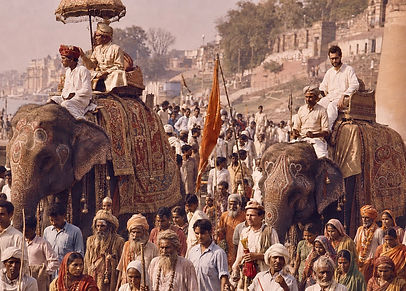
The Lovers’ Journey began with a question. While attending a ritual performance of the Ramayana on the banks of the Ganges, William Pennell Rock found himself wondering why this ancient story was regarded as sacred, and what blessing it held for those who entered it.
That question began a lifetime of investigation.
About William Pennell Rock
William Pennell Rock studied psychology at Yale University, comparative religion at Harvard Divinity School, philosophy at King’s College, Cambridge, and Sanskrit and the Upanishads at Banaras Hindu University. His work has also drawn on Jungian psychology and decades of teaching, experiential workshops, and personal inquiry.
Media Resources
Journalists, podcasters, reviewers, booksellers, and event organizers can find William Pennell Rock's official biography, author photographs, book information, cover art, interview topics, and other media resources.
William Pennell Rock is available for remote podcast, radio, print, and video interviews. By arrangement, interviews and filmed conversations may also take place in the peaceful setting of his home and garden.
Begin reading.
PROLOGUE
It all began in Kashi, the ageless Indian City of Light, now known as Varanasi. On the opposite shore of the holy Ganges, somewhat downstream, stand the crumbling walls, ramparts, and towers of a medieval castle, Ramnagar, the traditional seat of the Maharajah of Kashi. Every year at the end of the rainy season, the Maharajah revives an age-old tradition by staging the Ramlila, a ritual dramatization of the great epic Romance, the Ramayana.
In the late nineteen sixties, during my final year of an academic appointment at Banaras Hindu University, I was invited to join this public ritual. To attend, I had to cross the great roiling river with its swollen monsoon currents. Ferried over in a small creaky wooden boat that seemed as ancient as the holy city itself, I wondered why I was putting myself through this ordeal.
The Ramlila, quintessentially Hindu, was both dazzling and funky. Each scene took place in a different location in the vicinity of the castle, encompassing its temples, tanks, ponds and pools as well as the surrounding wilderness. Scores of pilgrims from every corner of India were in attendance and the entire area had become the familiar landscape of the epic. Between scenes, a grand procession wound its way in ceremonious languor through the luscious wilderness from one setting to the next. The Maharajah and his guests, including myself, led the procession, conveyed in howdahs mounted on elephants riotously painted and festooned. We were followed by a colorful cavalcade including performers in their costumes, servants, priests in white, assorted holy men in body paint and saffron loincloths, and the pilgrim multitude.
Only three scenes were performed on the day I attended, each enveloped in an elaborate ritual infused with much incense and chanting of priests. At this pace, the complete Ramlila lasted an entire month!
The Maharajas, unseemly rich before independence from Britain, had become desperately poor. Any non-essential remnant of their glorious past had crumbled away. The props and costumes were tatty and threadbare, the elephants worn-out. Yet there was a grandeur of dedication that emanated the miraculous. It flooded me with the soul-searching that had brought me to Asia in the first place.
I had not crossed the Ganges in ignorance. At the University I was researching the Sanskrit of the Upanishads, the essential scriptural verses of Hinduism. I knew, for instance, that ram is one of many names for God, and that lila means “play." But Sanskrit has resonances that are untranslatable. This was no simple “God at play," no mere entertainment for the masses. Here, for all to participate in, the Light and the Dark were being played out as the order of the divine.
In a popular way, the Ramayana is as basic to Hindu tradition as the Upanishads. Legend has it that almost two thousand years ago, when the sage Valmiki set the ancient tale into Sanskrit verse, he promised that whoever engages with this story will be blessed.
Why is this epic so vitally important in the Hindu universe? Why is each scene so holy and meaningful as to merit its own ritual?
What is the “blessing”?
INTRODUCTION
The Quest for the Ultimate Romance
The themes and lessons of the Ramayana are essential to Hindu culture throughout Southeast Asia. This is not just ethnic inertia. If we abstract the central story from its specific cultural context and look into global mythology and literature, we find one romance that has been told throughout the world since the beginning of time. In this story form there are universal teachings that constitute a blessing to the world, particularly in our perilous time.
For me "blessing" has a very practical and objective meaning: the best that we can experience in this human life. I see this in terms of the "divine," by which I mean the highest potential available universally to any human being. This is the promise not only of the Ramayana but the whole universe of stories of reunited lovers from all times and cultures.
That promise, that blessing is the Ultimate Romance.
Don't most of us have some sort of idea what an ultimate romance might be? If all dreams of connecting romantically were fulfilled, what might that be like? What is the sum and totality of it?
In recognition of this highest human aspiration I use "romance" evocatively, but the specific and actual meaning of this central question will emerge in the course of this book.
Given the title, readers may be dismayed to find that the titular Lovers and their Journey do not emerge until eight chapters into the book. This is because uncovering its form and meaning led me on a winding path around the world. The adventure was initiated by my discovery of another basic story, Joseph Campbell's Hero's Journey, which prompted the quest to understand the nature of transformation before Lovers appeared on the scene. The long introduction relates key passages in this quest before I even noticed this other universal story form. Then I had to assure myself that the form is actually irreducible before I could begin to explore its specific meanings. The Introduction mirrors the variety of approaches I needed to apprehend its blessing. This sets up the book's real purpose: to distill the form of the Lovers' Journey, contemplate its meaning, and explore its manifold applications.
The form in itself is invaluable for understanding romance stories and for creating or critiquing them. At the same time, it constitutes a universal gestalt that is a revelatory view of reality: simultaneously very ancient, yet very new and significant for the future. Closer examination reveals that the form is critically relevant to our individual and relational lives. In fact, it clarifies all transformation processes up to and including evolution itself. It is particularly vital in this our time, “the seminal idea of the twenty-first century.” This book is my attempt to fill out this promise.
Empirical science dreams of reaching towards the "objective reality" beyond the mind, independent of human perception. In distinct contrast, the universal Romance form is a core emanation of human intuition, an objectivity including all subjectivity. It projects an understanding of reality inherent in human consciousness itself. Thus, my initial approach does not look outward to empirical evidence, but inward. It does not look first into external workings but into human understanding itself, by which, as it turns out, external reality is itself formed. Other, more expert scientific minds have, as we shall see, discovered and proven the significance of this intuitive form across all reality.
One reason that it took so long to come to the meaning of the Lovers' Journey is because it is so close that we do not see it, and it is concealed further by the distracting thrill of lovers in our hearts. Coming to see the form and its lawful gestalt is compelling and useful, but realizing its fundamental meaning is the real gold. There is an element of alchemy in it. Accordingly the purpose of this book is not to present an argument or convey a body of objective knowledge about the Lovers' Journey. Rather, I conceive of the book as conducting a process to produce a deep intuitive understanding. The gold in this alchemy is called gnosis.
The account of my quest presents challenges. How did a Western academically trained intellectual come to experience, apprehend, and deploy this universal romance? I am told that my thinking and writing fall into a cultural no-man's land between the Ivy League and California, but extending the long way around via Europe, Asia and the Pacific. Though many essential human truths are to be found in such a journey, it is difficult to avoid losses in translation.
There are several advantages for Western readers, but also disadvantages. As a graduate student in philosophy at Cambridge I studied two of the most influential, though recondite twentieth-century European philosophers: Heidegger and Wittgenstein, both rebels of thought. This tended already to remove me from common Western ways of thinking. Then, for fifty years, while delving further into Indian and then Chinese philosophy, I took up and maintained an intensive meditation regime, which removed me even further.
In general, serious practice consists not of thinking, but of observing consciousness through formal processes that produce states and insight capable of opening up higher stages of being. They open points of view different and often opposed to common everyday awareness and sense of reality. Intensive and radical observation of the phenomenon of consciousness itself redistributes the sense of what is absolute and unchanging and what is cyclical and relative, an understanding which shows up subtly in ways of seeing, thinking and writing. Intellectual issues mysteriously resolve themselves through clarity, a dimensional awareness usually indicating contemplative experience. All of these advantage my take on Asian spirituality, but they present challenges as they may remove my thinking even further from common Western intellectual traffic.
If you are not a serious meditator or practitioner, if your source of information is primarily empirical, intellectual or academic, you may encounter difficulty "seeing" Asian spiritual and ontological reality. Subtle differences may be alarming and divisive. Consequently, parts of this book that I consider preparatory to understanding the universal blessing of the Lovers' Journey may be abstruse and difficult to understand.
In considering the reader, I have tried different ways to head off difficulties presented by the obscurity and multifold references. Rather than having an Index and Notes, useful to scholars, there is a very comprehensive Glossary at the end of the book, and I urge the reader to make liberal use of it.
Furthermore, my whole presentation is cubistic, approaching from differing perspectives. Some involve excursions into Asian or twentieth century philosophies that may seem impossibly opaque. However, I present the basic messages of the Lovers' Journey in varying ways and from different, often non-academic perspectives. Therefore, if any particular discussion is too difficult to negotiate, just skip to the next section or chapter. The matter will eventually be covered in other ways. Remember, the purpose of this book is not to assemble facts and arguments into a complex explanation, but to guide you by differing means to your own intuitive self-understanding.
In Part I of the book, "Journeys," I introduce most of the considerations preparatory to interpreting the Lovers' Journey. They include my own academic and intellectual questioning; an account of how humans have expressed intuitive understanding of transformation through cherished stories built on the archetypal journeys of Heroes and Lovers; and finally the matter of transformation itself and the quest for the Ultimate Romance, the blessing that is the real subject of this book.
The body of the book derives and describes the Lovers' Journey through a deep analysis of four of the world’s most famous Romances: Romeo and Juliet, Pride and Prejudice, the Ramayana, and the Star Wars romance of Princess Leia and Han Solo. Part II sets out the form itself. Part III explores the four main character elements found in the form. Part IV analyzes the interaction of these characters in the process of the Journey, which is broken down into five Acts.
Those interested only in the Lovers' Journey form itself may go directly to Parts II through IV, the body of the book. Those who want to know how I arrived at this formulation and how I came to understand its great teaching, will find the full account in the Introduction and Conclusion.
Part V, the Conclusion, opens up the ultimate blessing of the Romance form by showing how it is the universal law of transformation and establishing it as the basic intuition of all evolutionary process. The book ends by exploring the seminal idea of the twenty-first century, deploying the form to analyze, clarify and project comprehensive solutions in humanity's present crises.
The touchstone and constant guide on this winding alchemical path are romantic stories themselves. If you love romances, this book is a feast.
There are ways to enhance your enjoyment beyond what you may learn through my analysis. For instance, to enrich your experience and go deeper into the Romance, I encourage you to read or watch the four great romances named above, even if you are familiar with them. There is good reason that they are among the most beloved stories of all time.
Enchantment aside, it is not just our sentimental memories or favorite parts of stories where the gold is to be discovered, but in their universal structure. Thus, throughout the book there are strategically placed outlines, "maps" of famous romances, including our four stories, laid out according to the structure to illustrate subsequent discussion and analysis. Each map displays all the basic elements of the universal story form. The variety and number of stories provide a glimpse of the infinite ways that story-tellers have worked out the one Lovers' Journey.
For readers inclined to engage more deeply with the Lovers' Journey, the maps provide a further benefit. It's one thing to read my assertions that the form is powerful and universal: it's quite another to discover this hidden but indisputable power for yourself. To deepen your actual experience of this universal form, I invite you to choose your own favorite story of Lovers reunited and map it yourself.
To facilitate this process, starting with Part II, each chapter ends with a section called "Questioning the Romance." Answering the questions about your story will fill out your understanding. An even richer experience will result from choosing and working with a second, different kind of story, say a detective or horror story with a romantic component. If you happen to be writing a romance, you will profit greatly by using your work in progress. This foreshadows the enormous benefits of the form going forward as a guide for anyone who wants to tell stories of successful relationships.
Notwithstanding the many reasons for cherishing a story, which undoubtedly have their own value, the meaning and significance of the form itself is only to be found in the complete structure. Therefore, to prepare yourself for this interaction, please reread, watch or review a plot summary of your chosen story, as the questions will address essential aspects that you may have forgotten or overlooked.
This interaction will give you a taste of the experience of the Lovers' Journey. The Ramlila adventure was the experience that initiated my quest. I am not a practicing Hindu, and I only glimpsed the spectacle from the back of an elephant, but even twice removed, it was clear to me that the value of the Ramlila had to do not with theorizing, but with an immersive experience. Throughout my inquiry into the nature of the Journey, I have been very aware that, however beautifully and thoroughly I might be able to conceptualize the form, the real treasure comes from engaging with it. For this reason, in my life work I found ways to create an internal experience of the Romance by which I have come to explore and understand its real meaning.
Of course, we engage this form whenever we read or see a story of lovers separated and reunited. We involve it in the adventure of romance in our lives, the histories of our own relationships and our dreams. In the West, since the Middle Ages, romantic love has gradually displaced the Christian vision in the popular mind as the ultimate fulfilment of life. One out of two movies and pop songs celebrates this "religion" and its beliefs. Could this be prophetic, the outcropping of a new religious thought form responding to a new reality? In time we will consider this possibility as well.
The Ramlila festival gave me a glimpse into another kind of experiential engagement. Since that time, my intellectual pursuit, and even my own enthusiastic romantic life began to take the back seat to exploring the actual transformative potential of the form. The vehicle I created for this engagement has been ORIGINS, a protocol designed to produce immersive performing arts rituals inspired by the Ramlila. It is based on a workshop process developed to generate the actual individual experience of transformation. Here the Hero's and Lovers' Journeys become formulas for bringing about real personal transformation. The process is fundamentally therapeutic, because whenever you are suffering and stuck in a problematic situation, you are somewhere in a transformation process. If you can understand that process, you can diagnose where you are and see how to proceed.
The ORIGINS work is quite an adventure! It has also proven to be a remarkable laboratory. The experiences and insights into transformation that arose inform much of my interpretation of the Journey forms.
The fact that this workshop is not a "normal experience" may constitute another hurdle for anyone who has not undergone it. Few will have read the complete description of the ORIGINS Process found in my book Performing Inside Out. However, Chapters 7 and 8 of this book are an account of what happens in the basic Workshop. In part, this description is intended to orient the reader for further experiential references to this form. To further assist you as you continue reading, there is a summary of the ORIGINS Process in the Appendix. At any point when you might feel you are losing track of what ORIGINS is about, simply review this brief summary. Much of this book refers to the experience of the Lovers' Journey, because to me, the experience, not the theory, brings us to the heart of the matter.
My winding Journey of discovery culminated with the desire to share it in this book. After completing Performing Inside Out in 1990, I set out to relate my quest for the meaning and significance of the Lovers' Journey, intending to put everything in one volume. Over the years, however, the meaning, uses, and application of the form kept expanding. It soon became clear that this introductory book should be devoted to exploring the universal form and its rich interpretation in fiction, and the real, hands-on application and detailed analysis of its form should be separated out and elaborated in separate volumes.
The three further books, summarized in the Appendix, will explore in depth the applications of the Lovers' Journey in three areas. Volume II comprehensively lays out a new conception and methodology of psycho/spiritual development. Volume III explores the application to relationship, group, and collective development. And Volume IV covers its philosophical meaning, including the attainment of highest Self-realization and the nature of Being itself. Through this expansion of meaning, application and significance, the blessing of the Lovers' Journey reveals the Ultimate Romance.